Search
 Message

Company News
Seven principles to follow when selecting lubricating grease for bearings
Edit:Shandong Hanai Bearing Co., Ltd.Time:2025-12-31
The seven principles for selecting lubricating grease for bearings are:
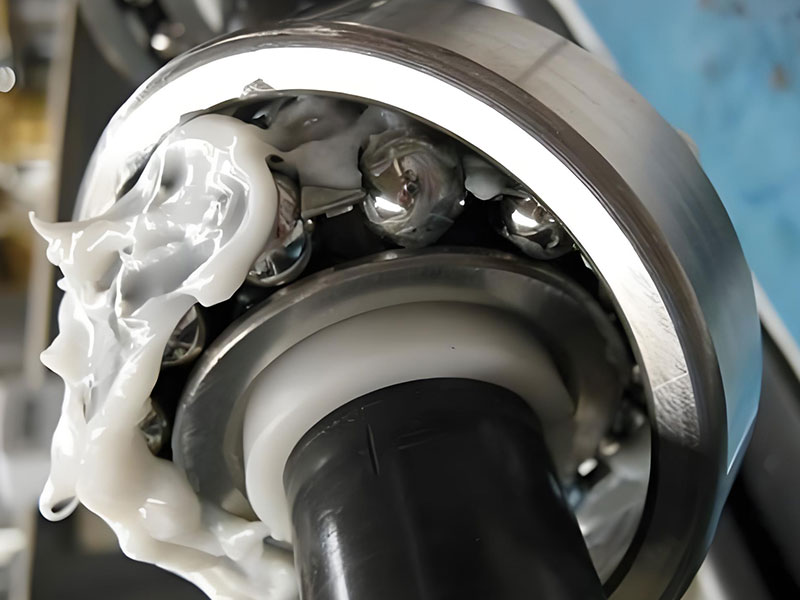
1. Environmental Conditions: When bearings operate under conditions of humidity, corrosive gases, low temperatures, dust, or strong radiation, lubricating oil is prone to contamination and deterioration. In such cases, lubricating oils with strong water resistance, anti-wear, corrosion resistance, cold resistance, and radiation resistance should be selected. In areas with severe splashing water, emulsion spraying, humid air, or heavy dust, lubricating oil is generally not suitable; instead, lubricating grease should be used.
2. Bearing Precision: When the moving friction surfaces of the bearing are rough, oils with high viscosity are generally suitable to withstand the locally high pressure formed by poor contact. Conversely, when the moving friction surfaces have high precision, low-viscosity lubricating grease should be selected to reduce unnecessary energy loss and temperature rise.
3. Operating Temperature: Operating temperature affects the viscosity change and lubrication effect of the lubricating oil. Therefore, when the operating temperature is low, low-viscosity lubricating grease should be selected; when the operating temperature is very high, high-viscosity lubricating grease or that with appropriate additives should be selected. When the temperature is extremely high, solid lubricants may generally be considered. The viscosity of the selected lubricating grease should also change with the ambient temperature. For example, when lubricating the same bearing, lower-viscosity lubricating grease should be selected in northern China or winter than in southern China or summer. When the operating temperature changes frequently, lubricating grease with excellent viscosity-temperature characteristics should be selected, meaning the viscosity of the lubricating grease changes little with the rise or fall of the operating temperature to ensure the oil film thickness remains stable within a certain range.
4. Motion Speed: The higher the rotational speed, the lower the viscosity of the lubricating grease should be to avoid increased motion resistance and excessive heat generation; conversely, at low speeds, lubricating grease with higher viscosity should be used to help improve load-carrying capacity.
5. Motion Nature: Impact, vibration, frequent variable loads, variable speeds, frequent starting, stopping, reversing, as well as reciprocating or intermittent motion during operation are not conducive to the formation of an oil film. Therefore, lubricating grease with higher viscosity should be selected. Sometimes, it is better to use lubricating grease or even solid lubricants to ensure reliable lubrication.
6. Working Load: The greater the load borne by the rolling bearing, the higher the viscosity of the lubricating oil should be, and it should have good oiliness and extreme pressure properties to prevent the lubricating oil from being squeezed out of the friction pair or direct metal-to-metal contact. The smaller the radial clearance of the rolling bearing and the higher the machining accuracy of the friction surface, the lower the viscosity of the lubricating grease should be.
7. Bearing Hardness: When the hardness of the moving friction surface of the bearing is low, lubricating grease with high viscosity should be selected, and the oil quantity should be sufficient; otherwise, the viscosity of the lubricating grease can be reduced.
 15266899192