Search
 Message

Company News
The Influence of Surface Treatment on the Performance of Cylindrical Roller Bearing Parts
Edit:Shandong Hanai Bearing Co., Ltd.Time:2025-12-31
There are significant differences in state, structure, and performance requirements between the working surfaces and the core of cylindrical roller bearing components. Conventional integral heat treatment often fails to satisfy both requirements simultaneously, and the potential of the material cannot be fully realized. The application of material surface strengthening technology not only effectively resolves the structural and requirement differences between the surface and the core but also enables the surface to acquire specific working properties to meet the performance demands of bearings operating under specific conditions. This is of great significance in the development of modern science and technology. Traditional surface strengthening methods fall within the scope of heat treatment. However, modern surface strengthening methods such as laser, electron beam, and ion beam technologies not only apply high-tech processes to material surface enhancement but also go beyond the boundaries of traditional heat treatment, forming a new technical field. Therefore, current surface strengthening technologies can be classified in various ways from different perspectives. Based on the physical and chemical processes involved, they can be broadly categorized into five types: Surface Deformation Strengthening, Surface Heat Treatment Strengthening, Chemical Heat Treatment Strengthening, Surface Metallurgical Strengthening, and Surface Film Strengthening.
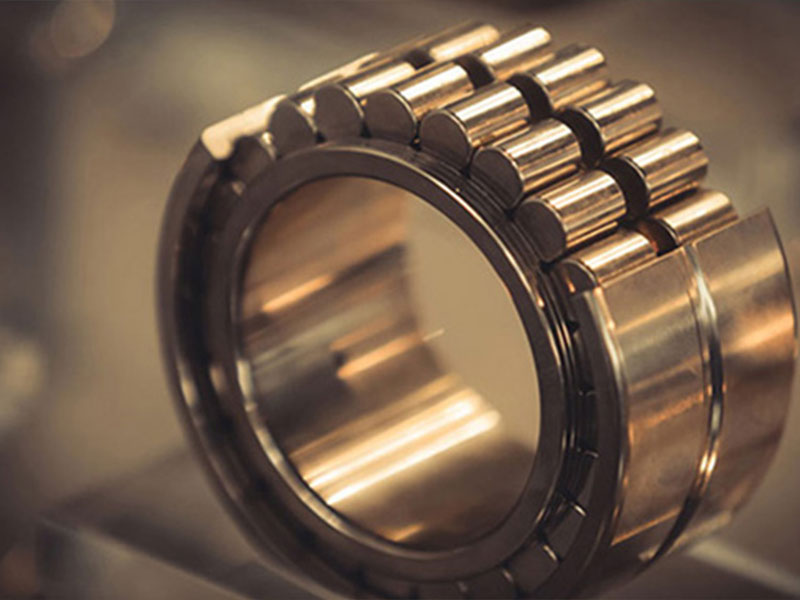
Surface Deformation Strengthening: A surface strengthening method that involves plastic deformation of the metal surface layer through mechanical means to form a hardened layer with high hardness and strength, also known as work hardening. This includes shot peening, sandblasting, cold extrusion, rolling, cold rolling, impact, and explosive shock strengthening. The characteristics of these methods are: increased dislocation density in the strengthened layer and refined sub-grain structure, thereby improving hardness and strength; reduced surface roughness; and significant enhancement of the part's surface fatigue strength and reduction in fatigue notch sensitivity. This strengthening method features simple processes and remarkable effects; there is no distinct boundary between the hardened layer and the substrate, ensuring structural coherence and resistance to peeling during use. Most of these methods have been applied in the bearing industry: surface impact strengthening of rolling elements is an application of this type, and precision rolling has become a new method for ring processing and strengthening.
Surface Heat Treatment Strengthening: A process known as surface quenching that utilizes solid-state phase transformation to quench the surface layer of parts through rapid heating methods. This includes flame heating quenching, high (medium) frequency induction heating quenching, laser heating, or electron beam heating quenching. The characteristics of these methods are: localized surface heating and quenching result in minimal workpiece deformation; rapid heating speeds lead to high production efficiency; and short heating times result in negligible surface oxidation and decarburization.
 15266899192